
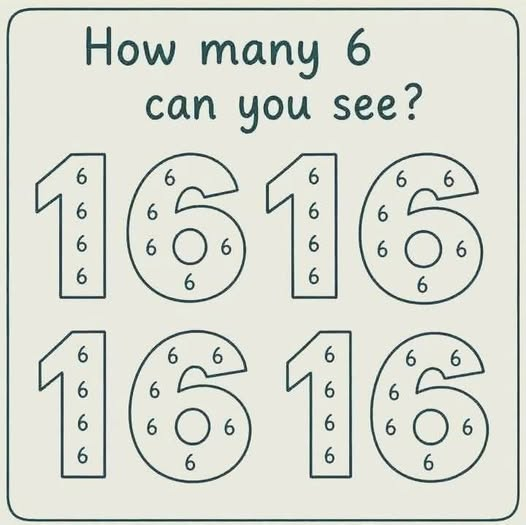
Observation puzzles love to overwhelm your visual cortex by hiding identical symbols inside larger versions of themselves. A viral brain teaser shown in image challenges users with a straightforward question: "How many 6 can you see?" While it looks like a quick counting exercise, almost everyone misses a few because the numbers are layered across three entirely different sizes.
To find the absolute total, you have to break the image down systematically:
The Question Text: Right at the top of the image, the text prompt contains 1 standard numerical digit "6".
The Large Outline Shapes: Looking at the large background figures, they spell out "1616" on the top row and "1616" on the bottom row. This gives us exactly 4 giant "6" shapes.
The Tiny Inset Numbers: This is where most people lose track. Inside the outlines, tiny "6"s are printed:
Each of the four giant "1" shapes contains exactly 4 tiny 6s (4 \times 4 = 16).
The top-left giant "6" contains 5 tiny 6s.
The remaining three giant "6" shapes each contain 6 tiny 6s (3 \times 6 = 18).
Adding the tiny numbers together gives 39 (16 + 5 + 18$). When you combine the 39 tiny 6s, the 4 giant 6s, and the 1 in the question text, the definitive grand total is 44!