
Here's a math problem that looks like it takes two seconds to solve. Most adults read it, immediately think they know the answer, and move on feeling confident. Most adults are wrong.
"A cellphone and a phone case cost $110 in total. The cellphone costs $100 more than the phone case. How much does the cellphone cost?"
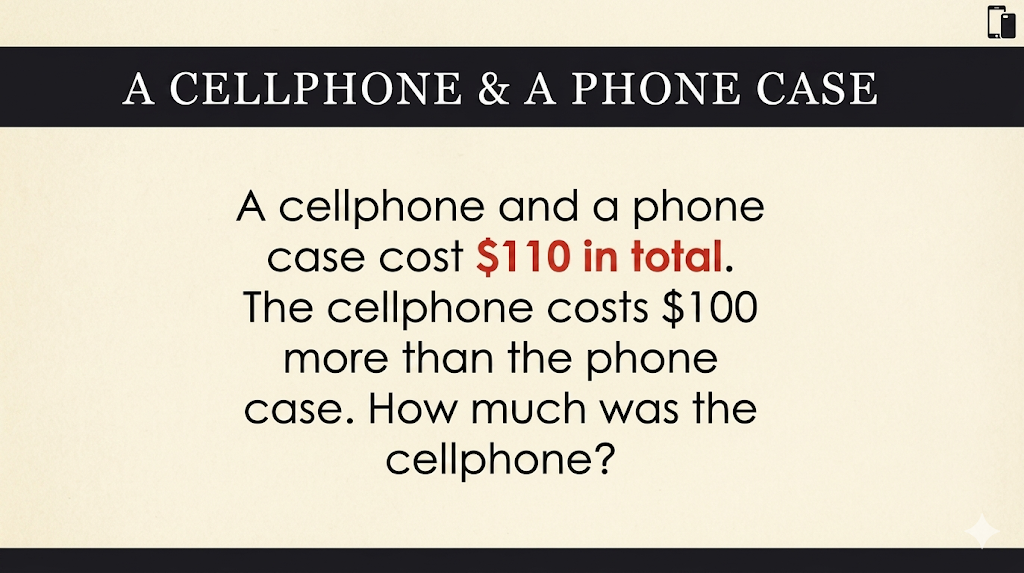
If your brain said $110, you're not alone. That's the wrong answer. If you said $100, still wrong.
Solution:
The correct answer is $105.
Here's why. Let's say the phone case costs X dollars. The cellphone then costs X plus $100. Together they total $110. So: X + (X + 100) = 110. That simplifies to 2X + 100 = 110, which gives you 2X = 10, so X = 5. The phone case costs $5. The phone costs $105.
The reason almost everyone says $110 is that the brain latches onto the biggest number in the problem and runs with it. It doesn't stop to actually do the math. It pattern-matches instead of thinking.
This is called the "bat and ball" problem in psychology — one of the most famous examples of how our fast-thinking brain overrides our slow, logical one. Daniel Kahneman wrote a whole book about it. Millions of people, including college students, get it wrong every single time.
The fix isn't being smarter. It's just slowing down for one second and setting up the actual equation instead of guessing from the gut.
Did you get it right the first time? Be honest.